
How Fashion Brands Cut Retouching Time by 90% with AI: Complete 2026 Guide
Fashion e-commerce brands spend 10-30 minutes manually retouching each product image—50+ hours per 200-SKU shoot. AI retouching cuts this time by 90%, reducing costs from $5-25 per image to pennies while maintaining professional quality. Learn how to implement AI-powered retouching workflows that save 45+ hours monthly and $16,200+ annually, with practical strategies for batch processing, preset development, and quality control.
You just wrapped a massive product shoot. The images look great—until you zoom in. Fabric wrinkles that weren't visible on set. A distracting shadow on the background. Color inconsistencies across the batch. Maybe even a stray prop that somehow made it into frame.
Now comes the soul-crushing part: spending the next three days manually retouching every single image in Photoshop. Welcome to the bottleneck that's silently killing your content velocity.
For fashion e-commerce brands operating on razor-thin margins and impossible deadlines, photo retouching isn't just tedious—it's a serious business problem. You're either hemorrhaging money on freelance retouchers, burning out your in-house team, or worse, publishing subpar images that hurt conversions. The math is brutal: if you're spending 15 minutes per image across 200 SKUs, that's 50 hours of pure retouching time. Every. Single. Shoot.
The explosion of AI-powered retouching tools has completely rewritten the rules of post-production. What used to take your team days now happens in minutes, with quality that's practically indistinguishable from manual work. But here's what nobody tells you: not all AI retouching is created equal, and knowing how to actually integrate these tools into your workflow makes the difference between modest time savings and completely transforming your content production pipeline.
The Real Cost of Traditional Retouching: Why Your Current Process Is Bleeding Money
Let's talk numbers. Traditional photo retouching for fashion e-commerce typically costs between $5-25 per image when outsourced, depending on complexity. For a mid-size DTC brand launching 50 new products monthly with 4-6 images each, that's $1,000-7,500 in retouching costs alone—every month. Scale that to a full seasonal collection, and you're looking at $12,000-90,000 annually just to make your product photos presentable.
The time investment is equally devastating. Manual retouching requires:
- Frequency separation for skin and fabric texture preservation
- Dodge-and-burn techniques for dimensional depth
- Color correction across multiple layers for consistency
- Precise masking for background cleanup and object removal
- Individual adjustments for every single image in your catalog
Even experienced retouchers need 10-30 minutes per image for professional-quality results. That's 33-100 hours for a modest 200-image product launch.
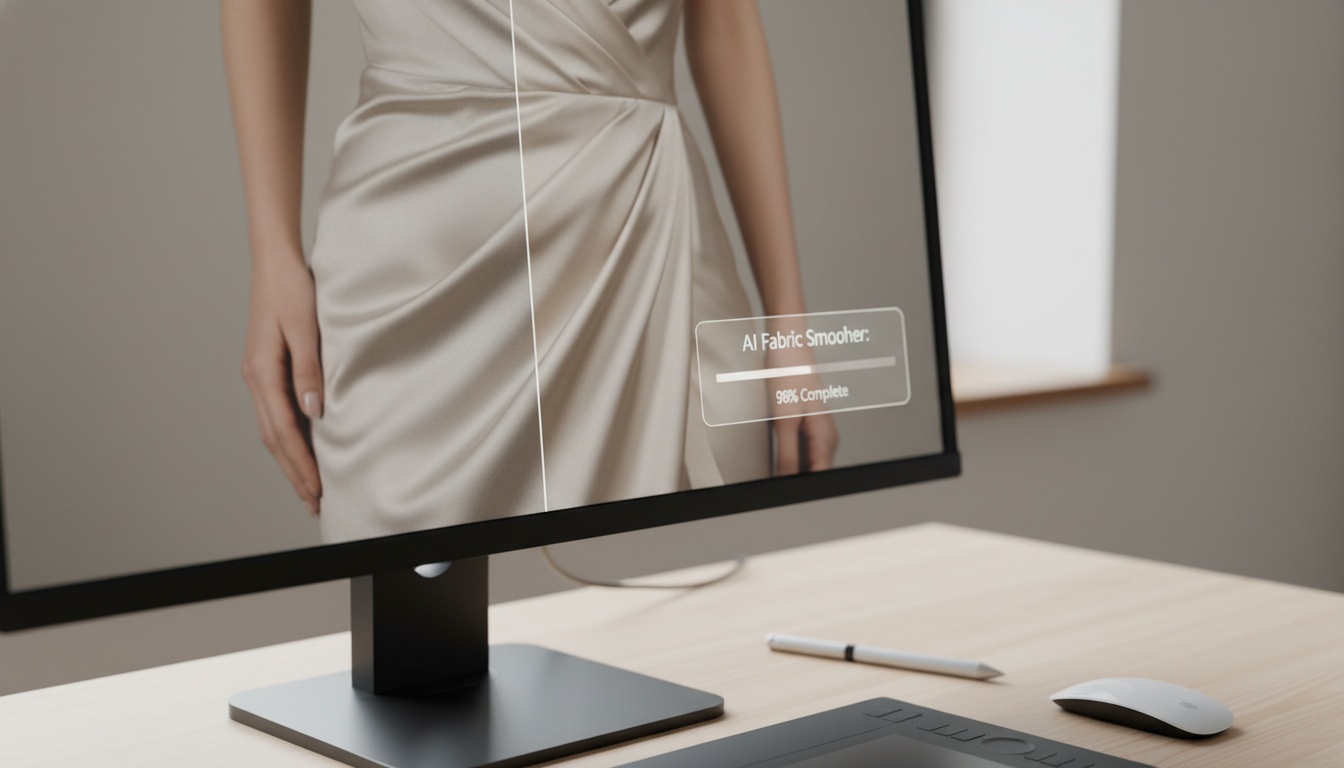
But the hidden cost is what really hurts: opportunity cost. Every hour spent pushing pixels in Photoshop is an hour not spent on strategy, creative direction, or scaling your content production. When your competitors are publishing 10x more content because they've automated their post-production, you're not just losing time—you're losing market share.
The traditional retouching bottleneck creates three critical business problems:
- Delayed time-to-market: Your products sit in the production queue for weeks while retouching backlogs pile up, missing critical seasonal windows and trend cycles.
- Limited content volume: You can't test multiple creative concepts or produce enough variations for A/B testing because each image requires significant manual labor.
- Scaling impossibility: Growing your product catalog means proportionally growing your retouching team or budget—there's no efficiency gain as you scale.
This is the reality for most fashion e-commerce brands in 2026: trapped in a production model designed for the pre-digital era, competing against brands that have already automated their way to 10x content output.
How AI Retouching Actually Works: The Technology Behind the Speed
Modern AI retouching tools use machine learning models trained on millions of professionally retouched images. These neural networks learn to identify and correct common issues automatically: skin blemishes, fabric wrinkles, color casts, distracting backgrounds, uneven lighting, and more. The key difference from traditional batch processing is that AI understands context—it knows the difference between fabric texture that should be preserved and wrinkles that should be smoothed.
The technology operates through intelligent masking and selective adjustments. Instead of applying blanket filters, AI identifies specific areas that need correction and applies targeted enhancements:
- Skin smoothing maintains natural texture while reducing blemishes and uneven tones
- Background cleanup removes distractions without creating obvious halos or edge artifacts
- Color correction adjusts for lighting inconsistencies while preserving the intended look of your products
- Object removal intelligently reconstructs surrounding areas when removing unwanted elements
- Fabric enhancement smooths wrinkles while maintaining material texture and drape
What makes this genuinely transformative is the batch processing capability. Apply retouching settings to one image, and the AI syncs those adjustments across hundreds of similar shots in seconds. For fashion brands shooting multiple angles of the same product or entire lookbooks with consistent lighting, this alone cuts retouching time by 90% or more.
The AI doesn't just replicate manual techniques faster—it learns from professional retouching standards and applies them consistently across your entire catalog. No more variation in quality between different retouchers or fatigue-induced mistakes on the 150th image of the day.
Practical Implementation: Getting Results Fast Without Disrupting Your Workflow
Start by identifying your highest-volume, most repetitive retouching tasks. These are your quick wins. Product images on white backgrounds? Background removal and color correction can be fully automated. Lifestyle shots with models? Skin smoothing, blemish removal, and facial enhancement take minutes instead of hours.
The workflow integration matters more than the tool itself. Look for AI retouching solutions that plug directly into your existing setup. If you're using Lightroom for organization and basic edits, you need AI tools that seamlessly import from and export back to Lightroom without file conversion headaches. If you're working with large teams, you need batch processing with preset sharing so everyone maintains consistent quality standards.
Set realistic expectations for AI-assisted versus fully automated retouching. Current AI technology handles about 90% of standard retouching tasks without human intervention. The remaining 10%—highly creative retouching, brand-specific stylistic choices, or complex compositing—still benefits from human oversight. The goal isn't to eliminate retouchers entirely; it's to free them from repetitive grunt work so they can focus on high-value creative decisions.
Create retouching presets tailored to your specific product categories. Wedding photography has different retouching needs than product photography, which differs from lifestyle content. Build a library of presets for your common scenarios:
- White background products: Automated background removal, color correction, shadow consistency
- Lifestyle shots: Skin smoothing, environmental cleanup, lighting balance
- Detail close-ups: Texture enhancement, blemish removal, color accuracy
- Model photography: Comprehensive skin retouching, wardrobe refinement, background optimization
This turns retouching from a creative decision into a one-click process, allowing junior team members to handle tasks that previously required senior retouchers.
Advanced Techniques for Maximum Efficiency: Beyond Basic Automation
Leverage selective subject retouching when working with multiple products or models in the same frame. Modern AI can identify individual subjects and apply different retouching profiles to each. This is game-changing for group shots, flat lays with multiple products, or lifestyle images where some elements need heavy retouching while others should remain natural.
Use AI object removal strategically. That stray thread, dust speck, or background distraction that would take 5 minutes to clone stamp out manually? AI removes it in seconds while intelligently reconstructing the surrounding area. This isn't just about speed—it's about removing friction from your approval process. When stakeholders request just remove that thing in the background, you can do it instantly instead of sending it back to the retouching queue.
Implement quality control checkpoints. Even with 90% accuracy, you're reviewing AI-retouched images anyway—but the review process is dramatically faster when you're checking for occasional mistakes rather than performing all the work yourself. Build a simple QA workflow:
- AI retouching happens first: Batch process all images through your preset workflows
- Human review catches edge cases: Quick scan for obvious errors or brand guideline violations
- Only flagged images get manual intervention: Your retouchers focus exclusively on the 5-10% that need human expertise
This approach maintains quality standards while achieving 90%+ time savings. Your team becomes quality controllers and creative directors rather than pixel pushers.
Develop brand-specific AI training by feeding your retouching AI examples of your ideal aesthetic. Many advanced platforms allow you to train custom models on your previous work, ensuring the AI learns your specific brand standards for skin tones, color grading, contrast levels, and stylistic choices. This eliminates the generic AI look and ensures consistency with your established visual identity.
The Business Impact: Real Numbers That Transform Your Bottom Line
Photographers using AI retouching report saving 18+ hours per month on average. For fashion e-commerce brands processing hundreds of images weekly, the math is even more dramatic. A brand shooting 200 products monthly can reduce retouching time from 50+ hours to under 5 hours—freeing up 45 hours for additional content creation, faster time-to-market, or simply reducing overtime costs.
The cost savings compound quickly. At $30/hour for professional retouching labor, cutting 45 hours monthly saves $16,200 annually. Scale that across a full marketing team handling multiple product lines, and you're looking at six-figure savings while simultaneously increasing content output.
But the strategic advantage goes beyond pure cost reduction:
- 10x faster iteration: Test multiple creative concepts in the time it used to take to produce one
- Real-time trend response: Capitalize on viral moments and seasonal trends before they pass
- Competitive content volume: Flood your channels with fresh content while competitors wait on retouching backlogs
- Improved conversion rates: More A/B testing means better-optimized product imagery
- Reduced team burnout: Eliminate soul-crushing repetitive work that drives talent away
In fashion e-commerce where speed-to-market directly impacts revenue, this operational advantage translates directly to competitive moat. When you can launch a 50-piece collection with complete visual assets in days instead of weeks, you're not just saving money—you're capturing market share from slower competitors.
The ROI calculation is straightforward: if AI retouching costs $50-200/month but saves you $1,350+ monthly in labor costs (45 hours × $30/hour), you're looking at a 675-2,700% return on investment. And that's before accounting for the revenue upside of faster launches and higher content volume.
How Milano AI Accelerates Your Entire Content Pipeline: Beyond Retouching
While specialized AI retouching tools solve one piece of the puzzle, Milano AI approaches the problem holistically—because retouching is just one bottleneck in your content production pipeline. Our AI-powered platform handles the complete workflow from product photography through final distribution, eliminating the fragmented tool chaos that slows down fashion e-commerce brands.
Create professional product photos without traditional shoots, then enhance them with AI-powered editing that handles background removal, color correction, and product refinement in plain English. Transform those product shots into lifestyle scenes, campaign imagery, and marketing videos without models, studios, or expensive photoshoots. The same AI that would take 15 minutes to retouch a single image in traditional software handles bulk uploads and generates complete e-commerce catalogs with white backgrounds, lifestyle contexts, and marketplace-optimized variations—all in minutes.
The integration goes deeper than just photo editing. Milano AI provides:
- Campaign Creator: Transform product photos into professional lifestyle imagery with models, locations, and seasonal aesthetics—no photoshoot required
- E-Commerce Creator: Generate marketplace-ready product photography with automated background removal, color correction, and angle variations
- AI Photo Editor: Handle any creative request in plain English—from complex retouching to complete scene transformations
- Video Campaign Builder: Create professional product videos and marketing content using pre-built templates
- SEO Content Generator: Produce daily optimized blog content that ranks on Google and ChatGPT
- Social Media Automation: Schedule and publish content across all platforms with AI-optimized captions
- Interactive Catalogs: Design shoppable lookbooks and digital catalogs without designers
- Live Shopping Experiences: Deploy interactive shopping features directly from your content
Everything operates from a single dashboard built specifically for fashion e-commerce, speaking your language and understanding your brand aesthetic. No more juggling between Photoshop, Lightroom, Canva, scheduling tools, and content management systems.
This is what true AI-powered efficiency looks like for fashion brands: not just faster retouching, but eliminating the entire traditional content creation workflow. Cut content costs by 95%, scale production 10x, and turn weeks of traditional workflows into minutes of AI-powered creation.
Implementation Roadmap: Your 30-Day Transition to AI-Powered Retouching
Week 1: Audit and Baseline
- Document your current retouching workflow and time spent per image type
- Calculate total monthly retouching costs (in-house labor + outsourcing)
- Identify your three highest-volume retouching tasks
- Start free trial with Milano AI to test on real product images
Week 2: Preset Development
- Create AI retouching presets for your top product categories
- Test batch processing on 50-100 images from recent shoots
- Establish quality control checkpoints and approval workflows
- Train team members on new AI-assisted processes
Week 3: Parallel Processing
- Run new shoots through both traditional and AI workflows
- Compare quality, speed, and cost between methods
- Refine presets based on quality control feedback
- Begin transitioning high-volume tasks to AI-first workflow
Week 4: Full Integration
- Make AI retouching the default for standard product photography
- Reserve manual retouching for hero campaigns and creative projects
- Measure time savings and cost reduction vs. baseline
- Scale to additional product categories and content types
By day 30, most fashion e-commerce brands achieve 70-90% reduction in retouching time and costs, with quality indistinguishable from traditional methods.
Common Mistakes to Avoid: Why Some Brands Fail at AI Retouching
Mistake #1: Expecting 100% automation from day one. AI retouching is incredibly powerful, but it's not magic. Brands that succeed treat it as AI-assisted retouching rather than fully automated retouching. Build in quality control checkpoints and human review for the first few months until you've refined your presets and workflows.
Mistake #2: Using generic consumer AI tools for professional work. Free AI retouching apps designed for Instagram selfies don't understand fashion e-commerce requirements. You need professional-grade tools built for commercial photography with proper color management, resolution handling, and batch processing capabilities.
Mistake #3: Skipping the preset development phase. The biggest time savings come from creating detailed presets for your specific product categories and brand aesthetic. Brands that skip this step end up manually adjusting every image anyway, negating most efficiency gains.
Mistake #4: Not training your team properly. AI retouching requires different skills than manual retouching. Your team needs to learn prompt engineering, quality control for AI output, and when to escalate to manual intervention. Budget time for training and workflow development.
Mistake #5: Treating AI retouching as a separate tool rather than integrated workflow. The magic happens when AI retouching is seamlessly integrated with your content creation, asset management, and distribution systems. Standalone tools that require manual file transfers and format conversions eliminate most efficiency gains.
The Future of Fashion Content Production: Why AI Retouching Is Just the Beginning
AI retouching represents the first wave of automation transforming fashion e-commerce content production. But the real revolution is the convergence of AI photography, retouching, and distribution into unified platforms that handle your entire content lifecycle.
The next 12-24 months will see:
- End-to-end AI content pipelines: From product photography to retouching to marketplace optimization to social distribution—all automated
- Real-time personalization: AI generating custom product imagery optimized for each customer segment and platform
- Predictive content creation: AI analyzing performance data to automatically generate high-converting visual variations
- Voice-controlled editing: Natural language commands replacing complex software interfaces
- Instant trend adaptation: AI monitoring fashion trends and automatically updating your content aesthetic
Fashion brands that adopt AI retouching today aren't just saving time and money—they're building the operational foundation for the next generation of content production. The competitive advantage compounds over time as you accumulate proprietary data, refined workflows, and team expertise that slower-moving competitors can't replicate.
Conclusion: Transform Your Retouching Workflow Today
The retouching bottleneck that's currently limiting your content production and draining your budget has a solution. AI-powered retouching isn't experimental technology anymore—it's production-ready, cost-effective, and delivering 90%+ time savings for fashion e-commerce brands worldwide.
The question isn't whether to adopt AI retouching, but how quickly you can implement it before your competitors gain an insurmountable content volume advantage.
Milano AI provides the complete solution: not just AI retouching, but the entire content creation and distribution platform built exclusively for fashion e-commerce. Create professional product photography, transform it into campaign imagery, retouch and optimize for every marketplace, generate marketing videos, automate social media, and manage your entire content strategy—all from a single dashboard designed for fashion brands.
Cut retouching time by 90%, reduce content costs by 95%, and scale production 10x. Stop spending days in Photoshop and start focusing on strategy, creativity, and growth.
Ready to eliminate your retouching bottleneck? Start with Milano AI's free trial—no credit card required. Upload your product images and see professional retouching results in minutes, not days.
Frequently Asked Questions
Fashion e-commerce brands typically save 90% of retouching time with AI. Manual retouching takes 10-30 minutes per image, while AI retouching processes images in 30-90 seconds. For a 200-product shoot requiring 800 images, this reduces retouching time from 50+ hours to under 5 hours—saving 45+ hours per shoot. Photographers report saving 18+ hours monthly on average, while high-volume fashion brands save 100+ hours monthly across their content production pipeline.
Scale Your Fashion E-Commerce with AI
Create professional campaigns and product photography in minutes. Start with 10 free credits—no credit card required.
Related Articles

ChatGPT vs Milano AI: Which AI Do Fashion Brands Actually Need in 2026?
Fashion brands adopting ChatGPT hit a wall fast: it helps with ideas but can't create the visual content, campaigns, and videos that drive revenue. Milano AI is the complete operating system for fashion e-commerce, cutting content costs 95% and scaling production 10x. Learn which AI your brand actually needs to compete in 2026.

How AI Tools Are Revolutionizing Creative Agencies: The Cause-Effect Analysis for Fashion E-Commerce Success
Creative agencies face an existential crisis: fashion e-commerce demands have exploded 10x while traditional production costs remain prohibitive. This cause-effect analysis reveals how AI tools like Milano AI are transforming agency operations—cutting costs 95%, increasing speed 10x, and elevating agencies from vendors to strategic partners. Real metrics show the inevitable effect of AI adoption versus the obsolescence facing agencies that resist.

Product Photography Tips: Q&A Guide for Fashion E-Commerce Brands
Master product photography for fashion e-commerce with this Q&A guide. Learn essential setup, lighting, color accuracy, and scaling tips—plus how Milano AI transforms simple product shots into full campaign imagery, cutting costs by 95% while scaling production 10x.