
11 SEO Strategies Fashion E-Commerce Brands Must Implement in 2026
Fashion e-commerce SEO drives qualified traffic without ad spend—but only if you implement the right strategies. This comprehensive guide reveals 11 proven tactics fashion brands use to dominate search rankings, from keyword strategy and site architecture to technical optimization and content scaling. Learn how to turn category pages into revenue engines, optimize product pages for conversion and rankings, and leverage AI to scale SEO content production by 10x while cutting costs 95%.
Fashion e-commerce SEO isn't optional anymore—it's the difference between paying $50 per customer on ads versus earning free, qualified traffic every single day. While paid channels get more expensive and attribution gets messier, ranking for high-intent keywords like "linen wide leg pants" or "black leather Chelsea boots" compounds over time with zero media spend. This guide breaks down 11 proven strategies fashion brands use to dominate search rankings, drive revenue, and scale content production without breaking the bank.
1. Why SEO Is Non-Negotiable for Fashion E-Commerce
If you sell fashion online, SEO is one of the few channels that compounds over time. Paid social gets more expensive, attribution gets messier, but ranking for "linen wide leg pants" or "black leather Chelsea boots" can drive qualified traffic every single day with no extra media spend.
For fashion in particular, SEO isn't just about "more traffic." It's about:
- Showing up for product-driven searches ("men's overshirt jacket", "plus size satin dress")
- Capturing trend and seasonal demand ("wedding guest dresses spring", "back to school outfits")
- Owning informational searches like how to style, what to wear, best jeans for, etc.
2. Nail Your Keyword Strategy Around Real Shopping Intent
Before tweaking pages, get clear on what your ideal customers actually type into Google when they're ready to buy.
- Group by intent:
Transactional: "buy black midi dress", "men's minimalist sneakers"
Commercial research: "best running leggings women", "vegan leather bags review"
Informational: "how to style wide leg trousers", "what to wear to a winter wedding" - Prioritize long-tail keywords: they're less competitive and much closer to purchase intent (e.g., "petite high waisted straight leg jeans" instead of just "jeans").
- Map keywords to page types:
Product keywords → product pages
Category/collection queries → category pages
Styling / "how to" / trends → blog, lookbooks, guides
3. Build a Clean Site Structure That Mirrors How People Shop
Fashion SEO lives or dies on site architecture. Search engines and shoppers should instantly understand how your catalog is organized.
- Use intuitive navigation: clear hierarchies like Women → Dresses → Midi Dresses, not confusing catch-all menus.
- Keep URLs short and descriptive:
/women/dresses/midi/black-satin-slip-dressbeats/prd?id=7843for both users and crawlers. - Control faceted navigation: let users filter by size, color, fit, but avoid index bloat from endless parameter URLs; use canonicals and noindex where needed.
- Link from templates, not just menus: key categories and bestsellers should be linked in headers, footers, and editorial blocks to signal importance.
4. Turn Category Pages into High-Value Landing Pages
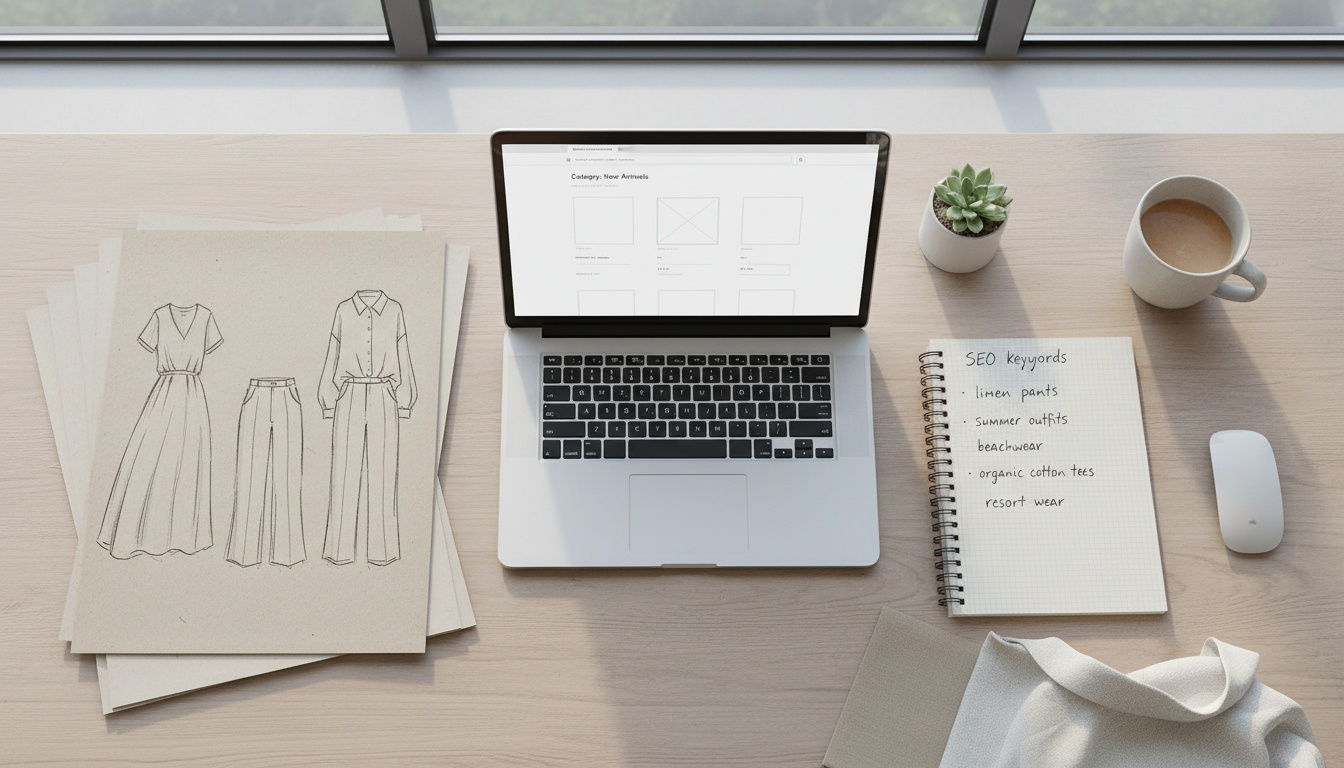
Category and collection pages are your money keywords landing spots ("women's trench coats", "men's running shoes"). They deserve more than a grid of products.
- Write a real intro section: 150–300 words that cover who the collection is for, use cases, key fabrics, fits, and styles—sprinkled with relevant keywords.
- Optimize headings & meta: include primary and secondary keywords naturally in H1, sub-headers, title tag, and meta description.
- Curate, don't just dump: feature bestsellers, new arrivals, and key sub-categories at the top to improve engagement and internal linking.
- Maintain seasonal relevance: refresh copy and featured products around drops (spring, festival season, back-to-work) to keep pages "fresh" in search.
5. Make Product Pages Do Double Duty: Convert & Rank
A product page should feel like a helpful salesperson and a fully optimized SEO asset.
- Unique, descriptive copy: no manufacturer boilerplate. Describe fabric, fit, styling suggestions, use cases, care, and who it's best for.
- Keyword-rich titles & metas: include brand, key attributes, and category (e.g., "Organic Cotton Oversized White T-Shirt – Women's Crew Neck").
- Structured data (schema): mark up price, availability, brand, SKU, reviews, and variations to qualify for rich results.
- Engagement boosters: size guides, fit finders, complete-the-look blocks, fabric close-ups, and styling tips keep visitors on the page longer.
- Handle variants smartly: decide when colors get separate URLs vs. one canonical page; align schema with how URLs are structured.
6. Treat Images & Video Like the SEO Assets They Are
Fashion is visual, and Google increasingly leans on image and video search for product discovery.
- Optimize image files: compress, use next-gen formats, and keep dimensions appropriate to avoid killing Core Web Vitals.
- Use descriptive filenames & alt text: "black-leather-chelsea-boots-men.jpg" plus alt text that describes the item and context.
- Invest in short-form video: 10–60 second clips of fit, movement, and styling, with keyword-rich titles and descriptions.
- Interactive visuals: 360° views, zoomable textures, and try-on demos improve engagement metrics that search engines pay attention to.

7. Fix the Technical SEO Issues That Quietly Kill Rankings
Many fashion sites lose SEO potential on the technical layer before content even matters.
- Prioritize speed & Core Web Vitals: image compression, script minimization, and CDNs to improve Largest Contentful Paint and interaction latency.
- Mobile-first, always: Google indexes based on your mobile site; test on real devices, not just desktop previews.
- Clean up indexation: noindex low-value filtered pages, prevent internal search results from being crawled, remove expired SKUs from sitemaps.
- Fix duplicates & redirects: use canonical tags for similar products, set 301s for retired items where you have close replacements.
- Structured sitemaps: dynamic XML sitemaps grouped by product, category, and content types help search engines find your key pages faster.
8. Use Content & Styling Guides to Capture Top-of-Funnel Demand
Blog posts, lookbooks, and styling guides let you tap into huge informational search volumes that eventually feed sales.
- Create "how to style" content: "how to style a trench coat," "what to wear with cargo pants," "outfits for summer city breaks."
- Trend & seasonal reports: festival outfits, office-ready looks, holiday party edits—each internally linking to relevant categories and products.
- Cluster topics: build topical authority around key themes (denim, activewear, occasionwear) with multiple interlinked articles and category pages.
- Update, don't just publish: refresh strong performers with new internal links, updated imagery, and current products every season.
9. Leverage Reviews, UGC & Links to Build Authority
Off-page signals still matter. For fashion, social proof and mentions are especially powerful.
- Showcase reviews & Q&A: aggregate ratings and user feedback on product pages; mark them up with schema for rich snippets.
- Encourage UGC: customer photos, "styled by you" galleries, and shoppable lookbooks increase engagement and link opportunities.
- Earn fashion-relevant backlinks: collaborate with bloggers, stylists, and online magazines to secure links to collections and hero products.
- Use anchor text intentionally: links should describe the destination ("linen wide leg pants") rather than generic "click here."
10. Track What Matters: From Rankings to Revenue
SEO for fashion e-commerce should be judged on business outcomes, not vanity metrics.
- Monitor organic traffic & rankings: especially for core category and product keywords.
- Tie SEO to revenue: track conversion rate, AOV, and total revenue from organic sessions, not just visits.
- A/B test page elements: try different product titles, images, and layouts to see what improves both conversion and SEO signals.
- Audit regularly: prune dead content, fix broken links, and re-optimize key pages based on performance data.
11. How Milano AI Helps Fashion Brands Win at SEO (Without More Headcount)
If all of this sounds like a lot to juggle on a lean team, that's exactly the problem Milano AI is built to solve.
Milano AI is a complete AI-powered platform built exclusively for fashion and e-commerce brands. It helps you execute many of the SEO best practices above faster and at scale, without relying on big creative or agency budgets.
- SEO-ready product & category visuals at scale: transform basic product photos into campaign-worthy images, lifestyle scenes, white-background shots, ghost-mannequin effects, and marketplace-optimized assets in minutes. This makes it easier to keep every key page rich with high-quality, optimized visuals that support rankings and conversions.
- Bulk content creation for large catalogs: generate unlimited visual variations for every SKU with bulk upload, so you can keep category pages fresh, test different creative angles, and support seasonal SEO updates without costly reshoots.
- AI-powered photo editing in plain English: quickly adapt imagery to match target keywords and search intent—change backgrounds, colors, or contexts to align with specific collections, seasons, or campaigns, while maintaining professional quality that feels indistinguishable from traditional photography.
- Full marketing automation suite around your SEO engine: launch video campaigns with templates, create AI avatar videos for product demos and styling tutorials, and automatically generate daily SEO-optimized blog content designed to rank on Google and ChatGPT. This directly supports your content clusters, "how to style" guides, and trend pieces.
- Cross-channel distribution from one dashboard: automate social posts, design interactive catalogs and lookbooks, and run live shopping experiences—ensuring that the traffic you earn from organic search is nurtured and converted across every touchpoint.
- Built for fashion teams of any size: from indie labels to enterprise retailers, Milano AI replaces large creative and marketing teams with intelligent automation that understands fashion, learns your brand aesthetic, and delivers content optimized for conversions across e-commerce platforms, social media, search engines, and AI recommendation systems.
In practice, that means you can cut content costs by up to 95%, scale production 10x, and compress weeks of SEO-supporting content work into minutes—all while keeping your store, categories, and products surrounded by high-quality, search-optimized visuals and content.
Milano AI isn't just another AI photo tool—it's designed to be the operating system for fashion e-commerce, helping you manage content creation, marketing, and growth from a single platform that works in harmony with your SEO strategy.
Frequently Asked Questions
Fashion e-commerce SEO is the practice of optimizing online fashion stores to rank higher in search engines for product-driven, commercial, and informational queries. Unlike paid advertising, SEO compounds over time—ranking for keywords like 'linen wide leg pants' or 'black leather Chelsea boots' drives qualified traffic daily with zero ongoing media spend. For fashion brands, SEO captures product searches, seasonal trends, and styling queries that directly lead to purchases, making it one of the highest-ROI marketing channels.
Scale Your Fashion E-Commerce with AI
Create professional campaigns and product photography in minutes. Start with 10 free credits—no credit card required.
Related Articles

Professional Product Videos with AI: Cut Costs 95% & Scale 10x | Milano AI Guide
Fashion brands spend $3,000-15,000 per video shoot, taking weeks to deliver. Milano AI creates professional product videos in minutes for 95% less cost. Learn how to turn product photos into campaign-ready videos, scale across channels, and automate your entire video marketing strategy with AI.

MidJourney vs Milano AI: Which AI Tool Wins for Fashion E-Commerce in 2026?
MidJourney creates stunning art, but Milano AI builds fashion businesses. Compare features, ROI, and real-world applications to discover why DTC brands and retailers choose purpose-built e-commerce platforms over general AI generators. Complete analysis with actionable strategies.

Fashion Photography AI: The Cause-and-Effect Revolution Cutting E-Commerce Costs by 95%
Traditional fashion photoshoots cost $5,000-$25,000 and take weeks. Fashion photography AI eliminates these causes entirely, producing professional campaign imagery in minutes for 95% less cost. Discover the cause-and-effect revolution transforming how e-commerce brands create content—from flat lays to conversion-optimized lifestyle photos, with real ROI metrics and implementation strategies.